%20(1)%202.svg)
Debt vs. Equity: A Founder’s Guide to Preserving Ownership and Extending Runway
.jpg)
You’ve got customers, orders, and demand, but the cash to fulfill them doesn’t always arrive on time. Inventory builds, big-box purchase orders, and DTC surges require upfront production. Fundraising timelines rarely keep pace with operations.
Many founders default to using equity to cover these gaps, but that can shrink runway, dilute ownership, and slow growth just when the brand is scaling. The smarter approach: use equity for growth and strategic investments, and use debt to fund operational needs that keep your business running smoothly.
When Equity Works and When It Doesn’t
Equity is best for big, long-term bets that increase enterprise value:
- Brand-building and marketing
- Product development or R&D
- Strategic hires
- Expanding into new channels
Using equity to cover operational needs, such as inventory, seasonal production, or fulfilling retail orders, can:
- Reduce runway
- Lock up cash in production cycles
- Dilute ownership unnecessarily
Rule of thumb: equity fuels growth; debt handles operations.
Why Debt Complements Equity
Structured debt, like an asset-based line of credit (ABL), funds operational cash needs while leaving equity for growth initiatives. It allows founders to fulfill orders, scale inventory, and manage seasonal spikes without giving up ownership.
ABL bridges the gap between slow, rigid bank loans and short-term, high-cost fintech lenders, offering a flexible, scalable, founder-friendly solution.
Debt complements equity by letting founders:
- Keep equity for strategic growth
- Preserve runway during seasonal or operational spikes
- Avoid scrambling for cash as orders and inventory scale
How Assembled Brands Helps CPG Brands
Our ABL solutions are built to work alongside equity, designed specifically for rapidly growing DTC, omnichannel, and e-commerce CPG brands.
Ideal partners are:
- 12+ months in market
- $8–10M+ in net revenue
- Growing consistently year-over-year
- Profitable, near break-even, or backed by investors with runway
- Experiencing seasonal cycles or multi-channel sales
What sets us apart:
- Flexible, founder-friendly structure: no lockbox, minimal covenants, no personal guarantees
- High advance rates on inventory and AR: up to 85% on AR, and 70% on inventory
- Scalable, accordion-style lines: automatically grow as receivables and inventory increase
- Reliable support during seasonal spikes and major retail wins
- Non-dilutive capital: equity stays for strategic growth
- Bridges the gap between fintech lenders and traditional banks
This approach ensures debt complements equity, funding operations while founders preserve ownership and runway.
Debt vs Equity: A Simple Framework for CPG Brands
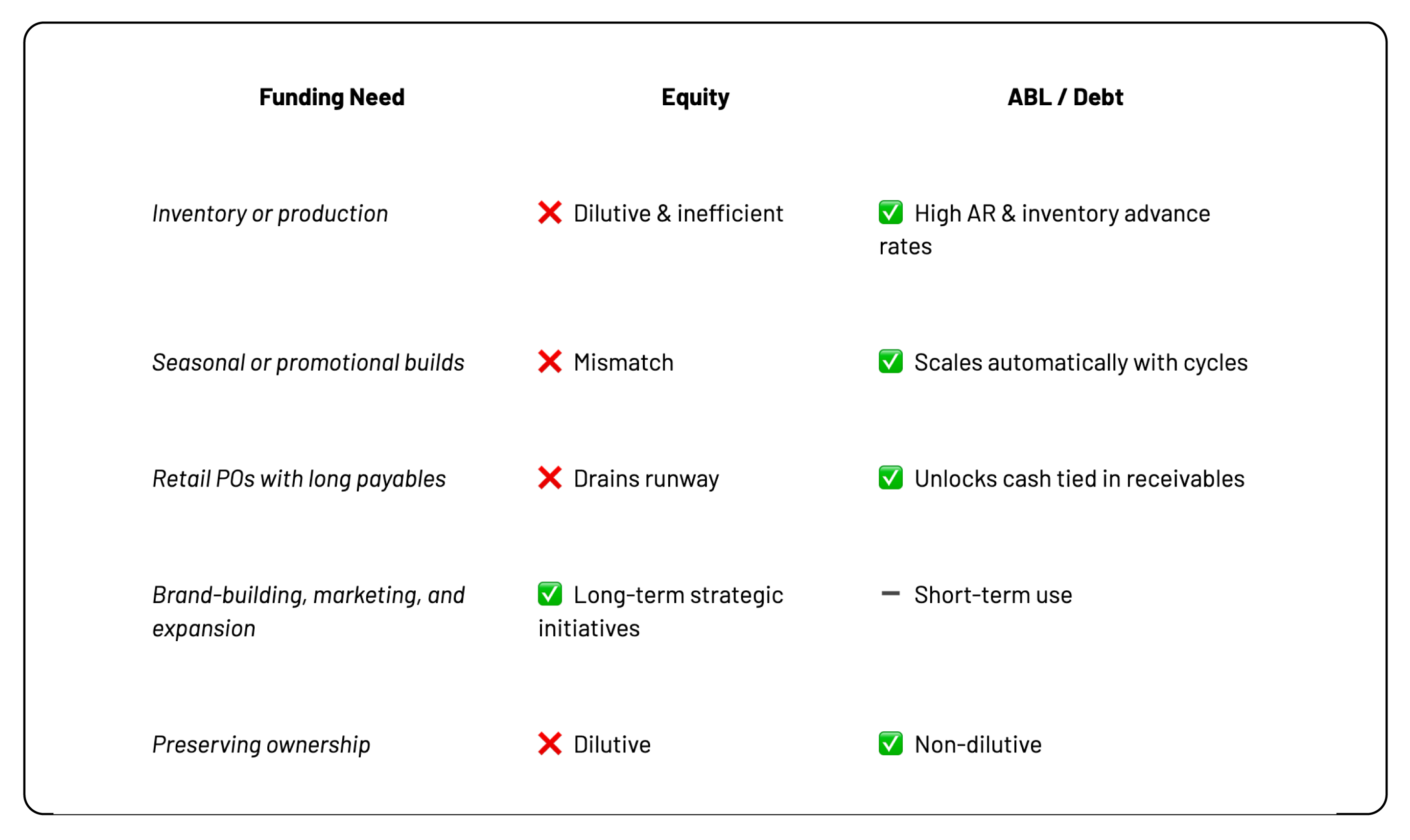
Making Capital Work for Your Brand
Balancing growth, operations, and ownership is one of the hardest challenges for CPG founders.
- Use equity for strategic initiatives that increase brand value.
- Use Assembled Brands’ ABL to fund inventory, production, and seasonal spikes without giving up ownership.
Together, they form a founder-friendly capital strategy that preserves runway, keeps operations smooth, and supports sustainable, high-growth success.

Related Articles



.avif)